
 ON SALE
 Create or manipulate Microsoft Excel documents from your .NET applications, without the need for Excel or Office to be installed. This is a fast and lightweight component, backed by a responsive support and development team whose sole ambition is your complete satisfaction.
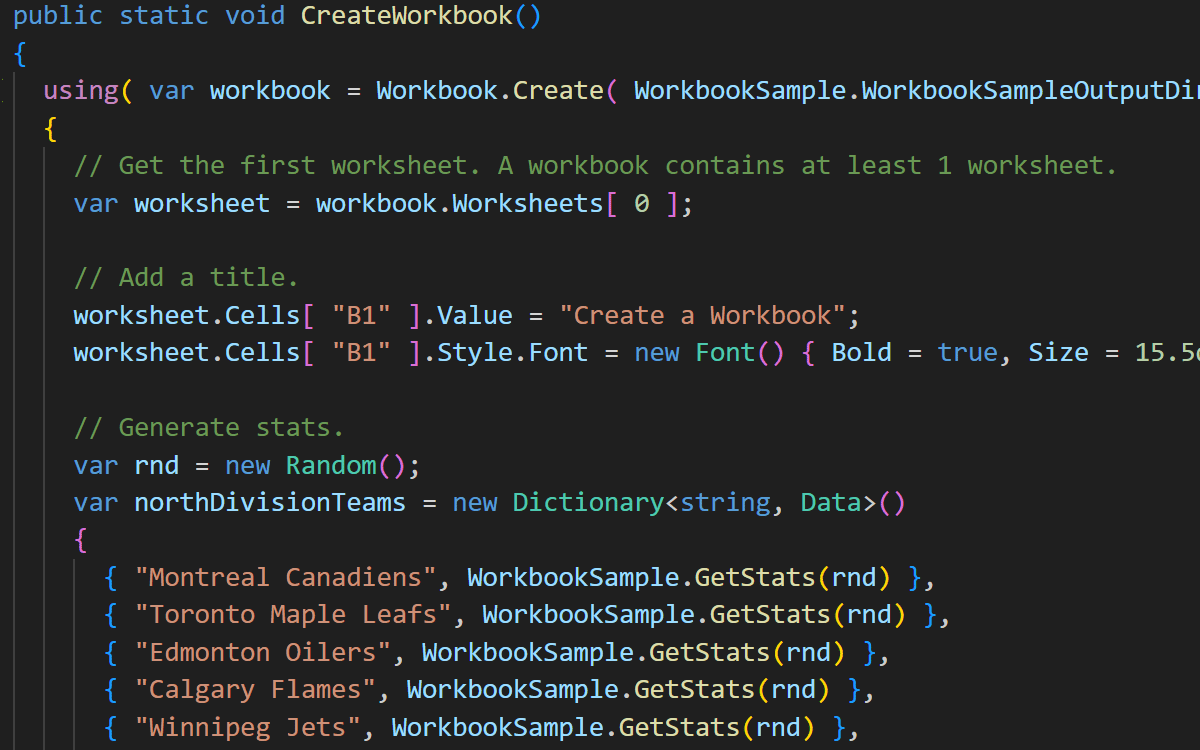



Xceed Workbooks for .NET is an Excel library for .NET that creates, reads and edits Microsoft Excel .xlsx files from C# and VB.NET code. It writes the Office Open XML format directly. Therefore it never needs Excel, Office or COM Interop on the machine that runs it. As a result, it works on web servers, inside Docker containers and in CI pipelines where installing Excel is not an option.
Want to see it run first? The live Xceed Workbooks for .NET demo opens in your browser, and the 45-day trial below needs no credit card.
The API mirrors the shape of an Excel workbook, so the code reads much like the document it produces. First you create a workbook, then you write values into cells, and finally you save. This example builds a small sales sheet, adds a real Excel table and calculates a formula.
using Xceed.Workbooks.NET;

// Apply your trial or purchased key once, at application startup.
Licenser.LicenseKey = "your-license-key";

using( var workbook = Workbook.Create( "SalesReport.xlsx" ) )
{
  var sheet = workbook.Worksheets[ 0 ];
  sheet.Name = "Q1 Sales";

  sheet.Cells[ "A1" ].Value = "Region";
  sheet.Cells[ "B1" ].Value = "Revenue";

  sheet.Cells[ "A2" ].Value = "North America";
  sheet.Cells[ "B2" ].Value = 128400d;
  sheet.Cells[ "A3" ].Value = "Europe";
  sheet.Cells[ "B3" ].Value = 96750d;

  sheet.Cells[ "A5" ].Value = "Total";
  sheet.Cells[ "B5" ].Formula = "=SUM(B2:B3)";

  // Turn the range into a genuine Excel table, not just formatted cells.
  sheet.Tables.Add( "SalesTable", "A1", "B3", TableStyle.TableStyleMedium9, true );

  workbook.CalculateFormulas();
  workbook.Save();
}
Reading an existing file follows the same pattern. You call Workbook.Load instead of Workbook.Create, change what you need, then call SaveAs to write a new copy. Because Workbook implements IDisposable, the using block closes the file for you.
Xceed Workbooks for .NET gives your application direct control over the contents of an .xlsx document. You can edit cell values, resize rows and columns, build formatted tables, and set formulas that the library then calculates. In addition, you can import collections straight into a worksheet with ImportData, add pictures and hyperlinks, and merge cell ranges.
Formatting works the same way. You can style cells, rows and columns with fonts, colours, alignments and number formats. Furthermore you can apply conditional formatting, add data validation rules, adjust the sheet view, and set the page layout for printing. Finally, you can protect a workbook or a single worksheet with a password.
Worksheet management is equally direct. You can add, insert, copy, move, hide or remove worksheets, and you can copy sheets between two different workbooks.
An Excel library for .NET can replace a reporting engine outright. Most reporting tools ask your team to learn a custom designer. Xceed Workbooks for .NET takes the opposite approach. Instead, you design the report in Excel, where your finance and operations colleagues already work, and then treat that file as a template.
At run time your code loads the template, fills in the data, recalculates the formulas and saves a copy per customer. Because the output is a normal .xlsx file, recipients open it in Excel, Google Sheets or LibreOffice without a viewer or a plugin. Teams commonly use this pattern for invoices, KPI dashboards, quarterly sales reports and data exports.
Before you pick an Excel library for .NET, check that it covers the frameworks you actually ship on. This one ships two builds in a single NuGet package, so the right assembly resolves automatically for your target framework.
| Target | Supported | Notes |
|---|---|---|
| .NET Framework 4.0 and up | Yes | Windows. Uses the net40 build. |
| .NET 5, 6, 7, 8 and 9 | Yes | Windows, Linux and macOS. Uses the net5.0 build. |
| ASP.NET and ASP.NET Core | Yes | Server-side generation needs no Office install. |
| Docker and Linux containers | Yes | Linux native drawing assets ship in the package. |
| C#, VB.NET and Managed C++ | Yes | CLS compliant, so every .NET language works. |
| Microsoft Excel installed | Not required | The library writes Open XML directly. |
Developers usually arrive here after hitting a wall with one of two alternatives. The table below sets out the practical differences.
| Approach | Needs Excel installed | Safe on a server | Commercial support |
|---|---|---|---|
| Xceed Workbooks for .NET | No | Yes | Yes, with a 1-year priority support subscription |
| Microsoft Excel COM Interop | Yes | No. Microsoft advises against server-side use | Through an Office licence only |
| Open-source .xlsx libraries | No | Yes | Community forums, with no service level |
Interop also routes every call through a desktop application, so throughput drops sharply under load. A managed Excel library for .NET avoids that bottleneck entirely, which keeps generation predictable on a busy server.
No. Xceed Workbooks for .NET writes the Office Open XML .xlsx format directly, so it needs no Excel installation, no Office licence and no COM Interop on the machine that runs your code. Consequently you can generate spreadsheets on a web server or inside a container.
The package targets .NET Framework 4.0 and up as well as .NET 5.0 and up, which covers .NET 5, 6, 7, 8 and 9. It also works with ASP.NET and ASP.NET Core, and it supports C#, VB.NET and Managed C++.
Yes, on .NET 5 and later. The package depends on Xceed.Drawing.NET, which ships SkiaSharp Linux native assets, so drawing and image support work inside Linux containers without extra system packages.
It does both. Call Workbook.Load to open an existing .xlsx file, modify cells, tables, formulas or formatting, then call Save or SaveAs. Many teams use this to populate a spreadsheet that a colleague designed in Excel.
Yes. You assign a formula through the Formula property on a cell, then call CalculateFormulas on the workbook or the worksheet. The library evaluates the supported formulas and stores the results in the saved file.
A free 45-day trial is available and needs no credit card. Paid subscriptions begin with the Small Business licence for companies under 1 million USD in annual revenue, followed by the Standard licence and the Blueprint licence, which adds full source code.
The team behind Xceed Words for .NET builds this library too, so it inherits years of work on Open XML documents. Xceed shipped the first release in 2021 and has followed a regular release cadence since then. You can review every build, together with its release notes, in the Product Updates section below.
Requests from subscribers drive much of the roadmap. If something you need is missing, the support forums are the fastest route to getting it considered.
Note that there is no refund for this product.
To continue enjoying our services without interruption, please contact our sales team to renew your subscription.
Try for 45 Days
If you already have a license, download this version and provide your license key.
Here are all the latest updates to this product
Release Date: September 14th, 2026
Build Number: 6.1.26464
Release Date: December 8th, 2025
Build Number: 5.2.25608.6677
Release Date: September 8th, 2025
Build Number: 5.1.25458.6668
Release Date: April 28th, 2025
Build Number: 5.0.25228.5786
Release Date: February 3rd, 2025
Build Number: 4.0.250103.5744
Release Date: Released Mar. 4, 2024
Build Number: Build 1.4.3
Release Date: Released Apr. 3, 2023
Build Number: Build 2.5.23177.21230
Release Date: Released Oct. 5, 2022
Build Number: Build 2.4.22471.15220
Release Date: Released May. 14, 2022
Build Number: Build 2.3.22263.20500
Release Date: Released Feb. 4, 2022
Build Number: Build 1.1.0
Check out Xceed’s Words and PDF Library bundle