
'Declaration<StyleTypedPropertyAttribute(Property="FocusVisualStyle", StyleTargetType=System.Windows.Controls.Control)> <XmlLangPropertyAttribute("Language")> <UsableDuringInitializationAttribute(True)> <RuntimeNamePropertyAttribute("Name")> <UidPropertyAttribute("Uid")> <TypeDescriptionProviderAttribute(MS.Internal.ComponentModel.DependencyObjectProvider)> <NameScopePropertyAttribute("NameScope", System.Windows.NameScope)> Public Class LayoutAnchorableItem Inherits LayoutItem
'UsageDim instance As LayoutAnchorableItem
[StyleTypedProperty(Property="FocusVisualStyle", StyleTargetType=System.Windows.Controls.Control)]
[XmlLangProperty("Language")]
[UsableDuringInitialization(true)]
[RuntimeNameProperty("Name")]
[UidProperty("Uid")]
[TypeDescriptionProvider(MS.Internal.ComponentModel.DependencyObjectProvider)]
[NameScopeProperty("NameScope", System.Windows.NameScope)]
public class LayoutAnchorableItem : LayoutItem
AvalonDock adheres to an MVVM design.
The Model is represented by the classes contained in the Xceed.Wpf.AvalonDock.Layout namespace. The classes in this namespace are the layout elements in a layout model (for example LayoutAnchorable/LayoutDocument, LayoutAnchorablePane/LayoutDocumentPane, LayoutAnchorablePaneGroup/LayoutDocumentPaneGroup, etc.) that are used directly in XAML within a DockingManager to describe how the layout is composed.
The View is represented by the classes contained in the Xceed.Wpf.AvalonDock.Controls namespace; these classes are a set of stylizable controls that show the user controls. The names of the view controls typically end with "Control" (for example, LayoutAnchorableControl is the view control, whereas LayoutAnchorable is the model element).
The DockingManager uses various classes (such as the LayoutItem and its derived classes) to perform the role of the ViewModel, preparing the model to be consumed by the view.
There is one and only one logical tree, which has the DockingManager as its root. Even if a control is placed in a different window (i.e., autohidden windows or floating windows), it always belong to the same logical tree below the DockingManager.
The LayoutContent-derived elements in the layout contained in the Layout property of class DockingManager are associated with the corresponding LayoutItem-derived objects when the layout changes.
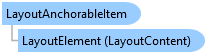
System.Object
System.Windows.Threading.DispatcherObject
System.Windows.DependencyObject
System.Windows.Media.Visual
System.Windows.UIElement
System.Windows.FrameworkElement
Xceed.Wpf.AvalonDock.Controls.LayoutItem
Xceed.Wpf.AvalonDock.Controls.LayoutAnchorableItem
| Name | Description | |
|---|---|---|
  | AutoHideCommandProperty | AutoHideCommand Dependency Property |
| CanHideProperty | CanHide Dependency Property |
| DockCommandProperty | DockCommand Dependency Property |
| HideCommandProperty | HideCommand Dependency Property |
| Name | Description | |
|---|---|---|
 | FindLogicalAncestor<T> | Finds the logical ancenster |
| FindLogicalAncestorsAndSelf | |
| FindLogicalChildren<T> | Find the logical children. |
| FindVisualAncestor<T> | Finds the visual ancestor. |
| FindVisualChildren<T> | Finds the visual children. |
| FindVisualTreeRoot | Finds the visual tree root. |
| ShowDialog | Overloaded. |
.NET: net5.0, net5.0-windows, net6.0, net6.0-macos, net6.0-windows, net7.0, net7.0-macos, net7.0-windows, net8.0, net8.0-browser, net8.0-macos, net8.0-windows, net9.0, net9.0-browser, net9.0-macos, net9.0-windows, net10.0, net10.0-browser, net10.0-macos, net10.0-windows.
.NET Framework: net40, net403, net45, net451, net452, net46, net461, net462, net463, net47, net471, net472, net48, net481.


