
[DebuggerNonUserCode()]
public class StringAssertions : FluentAssertions.Primitives.StringAssertions<StringAssertions>
System.Object
FluentAssertions.Primitives.ReferenceTypeAssertions<TSubject,TAssertions>
FluentAssertions.Primitives.StringAssertions<TAssertions>
FluentAssertions.Primitives.StringAssertions
| Name | Description | |
|---|---|---|
 | StringAssertions Constructor | Initializes a new instance of the StringAssertions class. |
| Name | Description | |
|---|---|---|
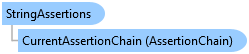
 | CurrentAssertionChain | Provides access to the FluentAssertions.Execution.AssertionChain that this assertion class was initialized with. (Inherited from FluentAssertions.Primitives.ReferenceTypeAssertions<string,TAssertions>) |
| Subject | Gets the object whose value is being asserted. (Inherited from FluentAssertions.Primitives.ReferenceTypeAssertions<string,TAssertions>) |
| Name | Description | |
|---|---|---|
 | Identifier | Returns the type of the subject the assertion applies on. It should be a user-friendly name as it is included in the failure message. Returns the type of the subject the assertion applies on. (Inherited from FluentAssertions.Primitives.StringAssertions<StringAssertions>) |
| Name | Description | |
|---|---|---|
 | Be | Asserts that a string is exactly the same as another string, including the casing and any leading or trailing whitespace. (Inherited from FluentAssertions.Primitives.StringAssertions<StringAssertions>) |
| BeAssignableTo | Overloaded. Asserts that the object is assignable to a variable of type T. (Inherited from FluentAssertions.Primitives.ReferenceTypeAssertions<string,TAssertions>) |
| BeEmpty | Asserts that a string is System.String.Empty. (Inherited from FluentAssertions.Primitives.StringAssertions<StringAssertions>) |
| BeEquivalentTo | Overloaded. Asserts that a string is exactly the same as another string, including any leading or trailing whitespace, with the exception of the casing. (Inherited from FluentAssertions.Primitives.StringAssertions<StringAssertions>) |
| BeLowerCased | Asserts that all cased characters in a string are lower-case. That is, that the string could be the result of a call to System.String.ToLowerInvariant, (Inherited from FluentAssertions.Primitives.StringAssertions<StringAssertions>) |
| BeNull | Asserts that the current object has not been initialized yet. (Inherited from FluentAssertions.Primitives.ReferenceTypeAssertions<string,TAssertions>) |
| BeNullOrEmpty | Asserts that a string is either a null reference (Nothing in Visual Basic) or System.String.Empty. (Inherited from FluentAssertions.Primitives.StringAssertions<StringAssertions>) |
| BeNullOrWhiteSpace | Asserts that a string is either a null reference (Nothing in Visual Basic) or System.String.Empty or white space (Inherited from FluentAssertions.Primitives.StringAssertions<StringAssertions>) |
| BeOfType | Overloaded. Asserts that the object is of the specified type T. (Inherited from FluentAssertions.Primitives.ReferenceTypeAssertions<string,TAssertions>) |
| BeOneOf | Overloaded. Asserts that the System.String is one of the specified validValues. (Inherited from FluentAssertions.Primitives.StringAssertions<StringAssertions>) |
| BeSameAs | Asserts that an object reference refers to the exact same object as another object reference. (Inherited from FluentAssertions.Primitives.ReferenceTypeAssertions<string,TAssertions>) |
| BeUpperCased | Asserts that all cased characters in a string are upper-case. That is, that the string could be the result of a call to System.String.ToUpperInvariant. (Inherited from FluentAssertions.Primitives.StringAssertions<StringAssertions>) |
| Contain | Overloaded. Asserts that a string contains another (fragment of a) string. (Inherited from FluentAssertions.Primitives.StringAssertions<StringAssertions>) |
| ContainAll | Overloaded. Asserts that a string contains all values present in values. (Inherited from FluentAssertions.Primitives.StringAssertions<StringAssertions>) |
| ContainAny | Overloaded. Asserts that a string contains at least one value present in values,. (Inherited from FluentAssertions.Primitives.StringAssertions<StringAssertions>) |
| ContainEquivalentOf | Overloaded. Asserts that a string contains the specified expected, including any leading or trailing whitespace, with the exception of the casing. (Inherited from FluentAssertions.Primitives.StringAssertions<StringAssertions>) |
| EndWith | Asserts that a string ends exactly with the specified expected, including the casing and any leading or trailing whitespace. (Inherited from FluentAssertions.Primitives.StringAssertions<StringAssertions>) |
| EndWithEquivalentOf | Overloaded. Asserts that a string ends with the specified expected, including any leading or trailing whitespace, with the exception of the casing. (Inherited from FluentAssertions.Primitives.StringAssertions<StringAssertions>) |
| Equals | (Inherited from FluentAssertions.Primitives.ReferenceTypeAssertions<string,TAssertions>) |
| HaveLength | Asserts that a string has the specified expected length. (Inherited from FluentAssertions.Primitives.StringAssertions<StringAssertions>) |
| Match | Overloaded. Asserts that a string matches the wildcardPattern. (Inherited from FluentAssertions.Primitives.StringAssertions<StringAssertions>) |
| MatchEquivalentOf | Overloaded. Asserts that a string matches the wildcardPattern. (Inherited from FluentAssertions.Primitives.StringAssertions<StringAssertions>) |
| MatchRegex | Overloaded. Asserts that a string matches a regular expression with expected occurrence (Inherited from FluentAssertions.Primitives.StringAssertions<StringAssertions>) |
| NotBe | Asserts that a string is not exactly the same as the specified unexpected, including the casing and any leading or trailing whitespace. (Inherited from FluentAssertions.Primitives.StringAssertions<StringAssertions>) |
| NotBeAssignableTo | Overloaded. Asserts that the object is not assignable to a variable of type T. (Inherited from FluentAssertions.Primitives.ReferenceTypeAssertions<string,TAssertions>) |
| NotBeEmpty | Asserts that a string is not System.String.Empty. (Inherited from FluentAssertions.Primitives.StringAssertions<StringAssertions>) |
| NotBeEquivalentTo | Overloaded. Asserts that a string is not exactly the same as another string, including any leading or trailing whitespace, with the exception of the casing. (Inherited from FluentAssertions.Primitives.StringAssertions<StringAssertions>) |
| NotBeLowerCased | Asserts that of all the cased characters in a string, some are not lower-case. That is, the string could not be the result of a call to System.String.ToLowerInvariant. (Inherited from FluentAssertions.Primitives.StringAssertions<StringAssertions>) |
| NotBeNull | Asserts that the current object has been initialized. (Inherited from FluentAssertions.Primitives.ReferenceTypeAssertions<string,TAssertions>) |
| NotBeNullOrEmpty | Asserts that a string is neither a null reference (Nothing in Visual Basic) nor System.String.Empty. (Inherited from FluentAssertions.Primitives.StringAssertions<StringAssertions>) |
| NotBeNullOrWhiteSpace | Asserts that a string is neither a null reference (Nothing in Visual Basic) nor System.String.Empty nor white space (Inherited from FluentAssertions.Primitives.StringAssertions<StringAssertions>) |
| NotBeOfType | Overloaded. Asserts that the object is not of the specified type T. (Inherited from FluentAssertions.Primitives.ReferenceTypeAssertions<string,TAssertions>) |
| NotBeSameAs | Asserts that an object reference refers to a different object than another object reference refers to. (Inherited from FluentAssertions.Primitives.ReferenceTypeAssertions<string,TAssertions>) |
| NotBeUpperCased | Asserts that of all the cased characters in a string, some are not upper-case. That is, the string could not be the result of a call to System.String.ToUpperInvariant. (Inherited from FluentAssertions.Primitives.StringAssertions<StringAssertions>) |
| NotContain | Asserts that a string does not contain another (fragment of a) string. (Inherited from FluentAssertions.Primitives.StringAssertions<StringAssertions>) |
| NotContainAll | Overloaded. Asserts that a string does not contain all of the strings provided in values. The string may contain some subset of the provided values. (Inherited from FluentAssertions.Primitives.StringAssertions<StringAssertions>) |
| NotContainAny | Overloaded. Asserts that a string does not contain any of the strings provided in values. (Inherited from FluentAssertions.Primitives.StringAssertions<StringAssertions>) |
| NotContainEquivalentOf | Overloaded. Asserts that a string does not contain the specified unexpected string, including any leading or trailing whitespace, with the exception of the casing. (Inherited from FluentAssertions.Primitives.StringAssertions<StringAssertions>) |
| NotEndWith | Asserts that a string does not end exactly with the specified unexpected, including the casing and any leading or trailing whitespace. (Inherited from FluentAssertions.Primitives.StringAssertions<StringAssertions>) |
| NotEndWithEquivalentOf | Overloaded. Asserts that a string does not end with the specified unexpected, including any leading or trailing whitespace, with the exception of the casing. (Inherited from FluentAssertions.Primitives.StringAssertions<StringAssertions>) |
| NotMatch | Asserts that a string does not match the wildcardPattern. (Inherited from FluentAssertions.Primitives.StringAssertions<StringAssertions>) |
| NotMatchEquivalentOf | Overloaded. Asserts that a string does not match the wildcardPattern. (Inherited from FluentAssertions.Primitives.StringAssertions<StringAssertions>) |
| NotMatchRegex | Overloaded. Asserts that a string does not match a regular expression. (Inherited from FluentAssertions.Primitives.StringAssertions<StringAssertions>) |
| NotStartWith | Asserts that a string does not start with the specified unexpected value, including the casing and any leading or trailing whitespace. (Inherited from FluentAssertions.Primitives.StringAssertions<StringAssertions>) |
| NotStartWithEquivalentOf | Overloaded. Asserts that a string does not start with the specified unexpected value, including any leading or trailing whitespace, with the exception of the casing. (Inherited from FluentAssertions.Primitives.StringAssertions<StringAssertions>) |
| Satisfy<T> | Allows combining one or more assertions using the other assertion methods that this library offers on an instance of T. (Inherited from FluentAssertions.Primitives.ReferenceTypeAssertions<string,TAssertions>) |
| StartWith | Asserts that a string starts exactly with the specified expected value, including the casing and any leading or trailing whitespace. (Inherited from FluentAssertions.Primitives.StringAssertions<StringAssertions>) |
| StartWithEquivalentOf | Overloaded. Asserts that a string starts with the specified expected, including any leading or trailing whitespace, with the exception of the casing. (Inherited from FluentAssertions.Primitives.StringAssertions<StringAssertions>) |
| Name | Description | |
|---|---|---|
 | As<TTo> | Safely casts the specified object to the type specified through TTo. |
| Awaiting | Overloaded. Invokes the specified action on a subject so that you can chain it with any of the assertions from FluentAssertions.Specialized.NonGenericAsyncFunctionAssertions |
| Enumerating | Overloaded. Forces enumerating a collection. Should be used to assert that a method that uses the yield keyword throws a particular exception. |
| ExecutionTimeOf<T> | Provides methods for asserting the execution time of a method or property. |
| Invoking | Overloaded. Invokes the specified action on a subject so that you can chain it with any of the assertions from FluentAssertions.Specialized.ActionAssertions |
| Monitor | Overloaded. Starts monitoring eventSource for its events. |
| Should | Overloaded. Returns an FluentAssertions.Specialized.ExecutionTimeAssertions object that can be used to assert the current FluentAssertions.Specialized.ExecutionTime. |
| Should | Overloaded. Returns an FluentAssertions.Primitives.EnumAssertions<TEnum,TAssertions> object that can be used to assert the current TEnum. |
| Should | Overloaded. Returns an object that provides various assertion APIs that act on a System.Text.Json.Nodes.JsonNode. |
.NET: net5.0, net5.0-windows, net6.0, net6.0-macos, net6.0-windows, net7.0, net7.0-macos, net7.0-windows, net8.0, net8.0-browser, net8.0-macos, net8.0-windows, net9.0, net9.0-browser, net9.0-macos, net9.0-windows, net10.0, net10.0-browser, net10.0-macos, net10.0-windows.
.NET Standard: netstandard2.0, netstandard2.1.
.NET Framework: net40, net403, net45, net451, net452, net46, net461, net462, net463, net47, net471, net472, net48, net481.