Xceed PDF Library 2.0 introduces 41 new features, 14 breaking changes, and 10 bug fixes delivering stronger document structure control, a modernized API surface, and production-ready signature support.
Are you searching for the best zip/unzip library for .NET? Consider Zip for .NET an option that stands out for its flexibility, reliability, and maturity. Trusted by Microsoft and thousands of developers worldwide, this library benefits from over 18 years of continuous improvement. As a result, Zip for .NET delivers unmatched performance, advanced features, and true peace of mind for every .NET project. Whether you’re building enterprise applications, handling massive data archives, or simply need seamless file management, Zip for .NET fits the bill.
In 2026, WPF remains the backbone for robust enterprise and line-of-business Windows applications. However, out-of-the-box WPF lacks modern controls, fresh themes, and true localization support. As a result, developers struggle with rigid MessageBox dialogs, dated UI, and time-consuming workarounds. Fortunately, Xceed Toolkit Plus for WPF solves these challenges by bringing 103+ essential controls, panels, and themes to your toolkit. This upgrade enables you to deliver next-generation Windows experiences that are beautiful, accessible, and global-ready.
.NET developer productivity tools are essential for teams aiming to deliver high-quality software quickly. Xceed’s suite of .NET developer productivity tools is engineered to accelerate your workflow, improve performance, and simplify complex tasks so you can focus on building great applications.
Delivering reliable .NET components isn’t just about writing great code—it’s about rigorous, repeatable testing. At Xceed, our quality assurance (QA) process is designed to ensure every release is stable, high-performing, and ready for production use. Here’s a transparent look at how we test our libraries and controls before they ever reach our customers.
If you need to generate Excel files from a .NET app, the good news is you don’t need Microsoft Office installed on the server (and you generally shouldn’t automate Excel via COM anyway). The modern approach is to generate .xlsx files directly using a library that writes the Open XML format.
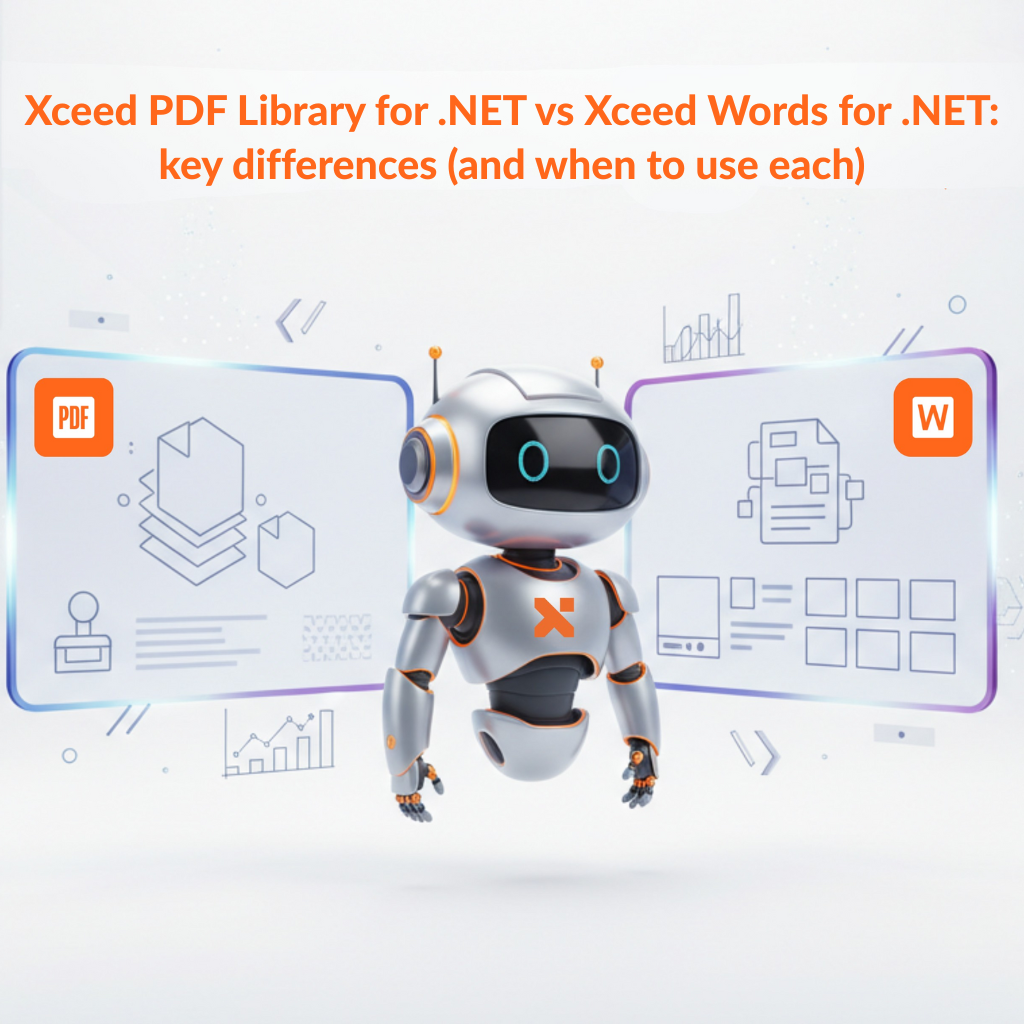
If you’re building .NET apps that generate, edit, or automate documents, it’s easy to lump “Word” and “PDF” into the same bucket. In practice, they solve different problems.
This post breaks down the practical differences between Xceed PDF Library for .NET and Xceed Words for .NET, so you can pick the right tool (or the right combo) for your workflow.
If you build .NET apps that need to output professional PDFs (invoices, reports, contracts, onboarding packets), you’ve probably felt the pain: heavy dependencies, awkward APIs, or “simple” libraries that get complicated the moment you need forms, signatures, or consistent typography.
Xceed PDF Library for .NET is a brand-new, lightweight way to build, edit, sign, and secure PDF documents directly from your .NET applications.
The concept is intentionally simple: an easy-to-use API that lets you add, modify, or extract elements to and from a PDF file without fighting the framework.
When your WPF app needs to render hundreds of thousands or even 1 million+ rows most grids start to choke. Scrolling stutters, the UI freezes, and users lose trust in the application.
In this guide, we’ll walk through how to render 1,000,000 rows in WPF without freezing the UI using Xceed DataGrid for WPF. We’ll compare a naive WPF grid to Xceed DataGrid with async data virtualization, show a simple benchmark, and give you code you can drop into your own app.
If you’re a .NET developer, you know the pain of piecing together UI controls, file handling libraries, and support systems from multiple vendors. Xceed Ultimate Suite eliminates that friction offering a single, robust toolkit that empowers you to build modern, high-performance applications faster and with less hassle.